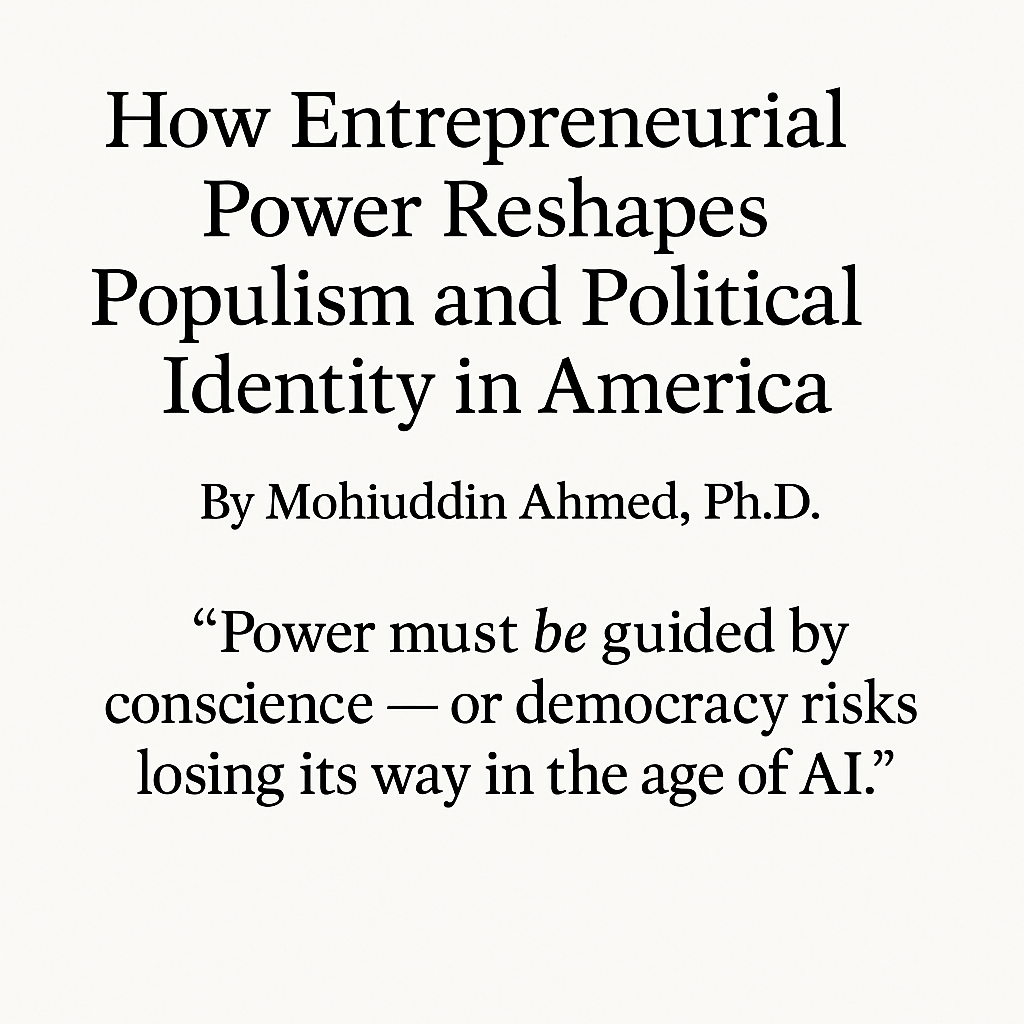
Contemporary Reflections: Entrepreneurs, Business Power, and Political Strategy

Introduction: When Business Meets Politics

A growing phenomenon in American life reveals that entrepreneurs are no longer content to remain behind the scenes. They are entering politics not merely as donors but as designers of policy—reshaping how the nation defines success, fairness, and identity.

This shift helps explain a critical question of our time: Why does MAGA-style populism retain such emotional and cultural appeal?

Beneath the slogans lies a strategic alliance: entrepreneurial elites seeking to shape the economic framework of the nation, and working-class citizens yearning for dignity, stability, and purpose. Together, they are redefining modern populism and the very meaning of political power.

Politics as an Extension of Business Strategy

Entrepreneurs understand that innovation alone cannot secure success. The ecosystem in which business operates—taxation, trade, labor laws, regulation, and cultural norms—is equally decisive.

Political participation has therefore become a logical extension of business strategy. By influencing policy, business leaders create not only favorable markets but also a cultural climate aligned with their values and vision of progress.

This is no longer traditional lobbying. It represents a systemic evolution—from competing within the market to shaping the rules that govern it.

A Convergence of Interests

The populist promise to “bring jobs back” resonated with two constituencies that once saw themselves as worlds apart.

For business elites, it suggested deregulation, lower taxes, and renewed domestic production.
For workers, it evoked dignity, pride, and the restoration of meaning to work and community.

This unlikely partnership has produced a new form of economic nationalism—pragmatic, emotionally charged, and fiercely identity-driven.

From Campaign Donors to Policy Architects

Today’s entrepreneurs—from Elon Musk and Larry Ellison to Peter Thiel and other influential digital and industrial innovators—no longer limit themselves to markets. They have become architects of public policy, shaping debates over energy, trade, technology, freedom, and the nation’s future direction.

Politics itself has become an advanced form of enterprise management, where success is measured not only in profit or votes but in the power to define values, narratives, and long-term purpose.

Global Reflection: Why Populism Feels Different Across Nations

In recent weeks, while watching documentaries on Siberia and Russia and reading History magazine on Libby, I developed a renewed appreciation for the cultural and psychological depth of reverence for centralized authority in Russian society.

This reverence persists even when authority becomes despotic. It reflects centuries of harsh geography, spiritual traditions, national mythology (“Mother Russia”), and collective memory that Western analysts often overlook.

This pattern extends across many regions: Afghanistan, the Middle East, parts of Africa, and numerous post-colonial societies. Populist causes there cannot be understood through Eurocentric ideals alone.

Here in the United States, democratic traditions run deep, and the political pendulum swings back and forth with relative stability. But in Russia, North Korea, Afghanistan, and similar nations, Eurocentric assumptions do not easily apply.

Many of us raised in Western-style educational traditions—often representing a small, elite minority shaped by colonial histories and blended identities—were taught to view liberal democracy as a universal model. Today, it is clearer than ever that it is not universally transferable.

The Moral Question: What Should Guide Power?

All of these dynamics bring us back to a timeless philosophical question: To what end is power exercised?

Throughout history, civilizations have been shaped by control over land, production, and trade. Today, the primary resource is policy itself—and those who shape it influence both material outcomes and the moral direction of society.

Transactional pursuits sustain life, but idealism sustains civilization.

Idealism—grounded in democratic principles, universal spiritual values, and expressed through diverse religious traditions—affirms equality, justice, the dignity of the individual, and our yearning for connection with a Universal Force that transcends personal circumstance.

A healthy society requires balance between pragmatic interest and ethical purpose, nationalism and global belonging, sovereignty and solidarity, material ambition and spiritual continuity.

Human history swings like a pendulum through these tensions. Leadership—corporate, political, intellectual, and technological—must ensure that power remains guided by principle and that prosperity serves human dignity.

AI and the New Struggle Over Truth

The convergence of entrepreneurial influence, populist identity, and modern media has now been magnified by a powerful new force: AI.

AI can illuminate truth—or blur it. Its ability to generate highly refined narratives, emotionally appealing arguments, and persuasive messages makes it a potential tool for deeper understanding—or sophisticated propaganda.

This reality demands a new level of reflective judgment from citizens, leaders, educators, and institutions. We must learn not only to evaluate content but to question how and why it was generated.

AI challenges us to engage our conscience more urgently than ever.

Conclusion: A Call for Ethical Leadership

We stand at a pivotal moment.

The fusion of entrepreneurial power, populist emotion, global identity struggles, modern media, and AI-driven narratives is reshaping democratic life.

If guided by vision and conscience, these forces can redirect innovation toward the common good. If driven by ambition and manipulation, they may deepen inequality, distort reality, and weaken democratic trust.

True progress requires the integration of intelligence with conscience—aligning creativity, technology, and ethical purpose.

In an age increasingly shaped by AI, this alignment is not optional. It may determine the fate of democracy itself.


Related Readings


Hashtags for Cross-Platform Sharing

.#Entrepreneurship
#Populism
#PoliticalStrategy
#AIandSociety
#EthicsInLeadership
#MoralLeadership
#AmericanIdentity
#ExistentialPerspectives
#Democracy
#MediaPsychology
#Advertising
#Globalism
#PoliticalIdentity
#UniversalHumanity
#PublicPolicy


Migration, Globalization, and Technological Advancements: Conflicts and Evolutionary Adjustments

The current global political and social landscape can be understood as a complex interplay of conflicts and adaptations driven by migration, globalization, and technological advancements. These forces have historically shaped human societies, influencing territorial boundaries, cultural identities, and economic systems. Today, they continue to fuel tensions between protectionist impulses and the ideals of openness, creating a dynamic process of conflict and evolution.

Historical Context: Migration, Territoriality, and Identity

Throughout history, human societies have been shaped by the dual impulses of territorial protection and expansion. From ancient conquests and wars to colonization and trade, migration has been a central force in the redistribution of people, resources, and ideas. These movements have often been driven by the need to secure resources, protect cultural identities, or expand influence. At the same time, they have led to the exchange of goods, knowledge, and traditions, fostering interconnectedness and cultural hybridity.

This behavior mirrors territorial instincts observed in the animal kingdom, where species defend resources critical to survival. However, humans have transcended purely instinctual behavior through the development of civilization, culture, and universal ideologies. Movements advocating for human rights, the emergence of major religions, and the spread of philosophical ideals reflect a growing conviction of unity—a recognition of all people as part of a shared human society. These ideals have promoted diversity and egalitarian principles, emphasizing the inherent rights of every individual to freedom, dignity, and opportunity.

Yet, the realization of these ideals has been uneven. Disparities in economic and social advancement have reinforced divisions, creating tensions between those who benefit from openness and those who feel threatened by it. This tension is not new; it has recurred throughout history, manifesting in cycles of protectionism and openness.

The Dialectic of Protectionism and Openness

The interplay between protectionism and openness can be understood through Hegel’s dialectical framework of Thesis, Antithesis, and Synthesis. In this model, the Thesis represents an established paradigm—such as globalization—while the Antithesis emerges as resistance to it, exemplified by protectionist and nationalist movements. Over time, the interaction between these opposing forces leads to a Synthesis, which reconciles elements of both and propels political and social evolution.

Protectionism—defending territorial boundaries, restricting migration, and limiting trade—often arises from fears of cultural erosion, economic instability, or threats to national security. It reflects a desire to preserve existing identities and systems. Conversely, openness promotes the free exchange of goods, ideas, people, and technologies, fostering interconnectedness and mutual progress. This dynamic tension is a recurring theme in human history, shaping the evolution of societies.

Assimilation and Accommodation: Cultural and Societal Adaptation

Jean Piaget’s theory of Assimilation and Accommodation provides further insight into how societies adapt to the movement of people, ideas, and technology. Assimilation occurs when new experiences are integrated into an existing framework, such as the adoption of foreign technologies or cultural practices. For example, the introduction of new crops, spices, and technologies through trade and migration has often been seamlessly integrated into local economies and cultures.

Accommodation, on the other hand, involves restructuring societal norms and systems to adapt to novel influences. This process is often more disruptive, as it requires fundamental changes to existing structures. For instance, colonization forced indigenous populations to restructure their political, economic, and religious systems, while colonizers themselves often adopted elements of local cultures, creating hybrid systems.

In the modern era, globalization continues to drive cycles of assimilation and accommodation. Immigrant populations introduce cultural practices—such as cuisine, music, and language—that are often assimilated into host societies. Simultaneously, societal structures, such as legal systems, education, and urban planning, undergo accommodation to address the needs of diverse populations. Technological innovations, such as digital communication and artificial intelligence (AI), are also being integrated into daily life, reshaping labor markets, education systems, and governance models.

Tensions and Resistance: The Role of Protectionism

These processes of assimilation and accommodation are not without tension. Resistance often arises when cultural or economic disruptions threaten existing identities or create inequality. Protectionist and nationalist movements seek to slow or reverse these processes, reflecting fears of cultural erosion or economic dislocation. Recent years have seen a resurgence of such ideologies, as evidenced by movements like “Make America Great Again” (MAGA) in the United States and similar nationalist efforts in Argentina, Brazil, and Europe. These movements resonate with populations who feel left behind by globalization, appealing to cultural anxieties and economic grievances.

However, the interconnected nature of globalization—particularly through advancements in technology and AI—makes it unlikely that such movements can fully reverse these trends. Instead, societies are more likely to enter a period of recalibration, balancing openness and protectionism to restore stability. This recalibration aligns with Hegel’s notion of synthesis, wherein a new framework emerges that incorporates elements of both global openness and local protectionism.

Artificial Intelligence: A Catalyst for Dialectical Change

Artificial intelligence exemplifies this ongoing dialectical process. AI accelerates the movement of ideas, knowledge, and innovation, reshaping industries, economies, and cultural exchanges. As AI becomes increasingly integrated into daily life, it reflects societal norms (assimilation) while also driving profound changes in governance, ethics, and labor systems (accommodation). The transformative potential of AI highlights the tension between the opportunities it creates and the challenges it poses, such as job displacement, ethical dilemmas, and misuse. In this sense, AI embodies both the promise of openness and the anxieties that fuel protectionist impulses.

The Path Forward: Synthesis and Evolution

The current era represents a transitional phase in humanity’s evolution. As with past upheavals, the resolution of these tensions will shape political, social, and economic landscapes for decades to come. These trends challenge us to reconsider fundamental questions: How do we balance belonging with inclusion? How do we protect individual rights while fostering collective well-being in an interconnected world? How do we navigate the tension between preserving cultural heritage and embracing inevitable change?

Ultimately, these challenges call for reflection on the deeper implications of movement—whether of people, goods, technology, or ideas—on personal and social well-being. They urge us to reevaluate the principles that underpin modern society, seeking pathways toward a future that honors both the diversity of human experience and the universal aspirations for dignity, opportunity, peace, and harmony that we all share.

In this broader context, the current conflicts and adjustments are not merely disruptions but part of an ongoing evolutionary process. By embracing the dialectical interplay of protectionism and openness, assimilation and accommodation, humanity can navigate these challenges and move toward a more inclusive and equitable future.

Please note: This is one in a series of blog posts by Mohiuddin Ahmed, published under the blog title Existential Perspectives at existentialperspectives.wordpress.com, established in 2014. Unauthorized use and/or duplication of this material without the express written permission of the author is strictly prohibited. Excerpts and links may be used, provided that full and clear credit is given to Mohiuddin Ahmed and Existential Perspectives, along with a direct link to the original content.