Reflections on Singularity, Divinity, and Dostoyevsky
This reflection was prompted by a quote from Swami Vivekananda that my nephew recently shared with me:
“Each soul is potentially divine. The goal is to manifest this divinity within.”
My own reflection diverges slightly—but meaningfully.
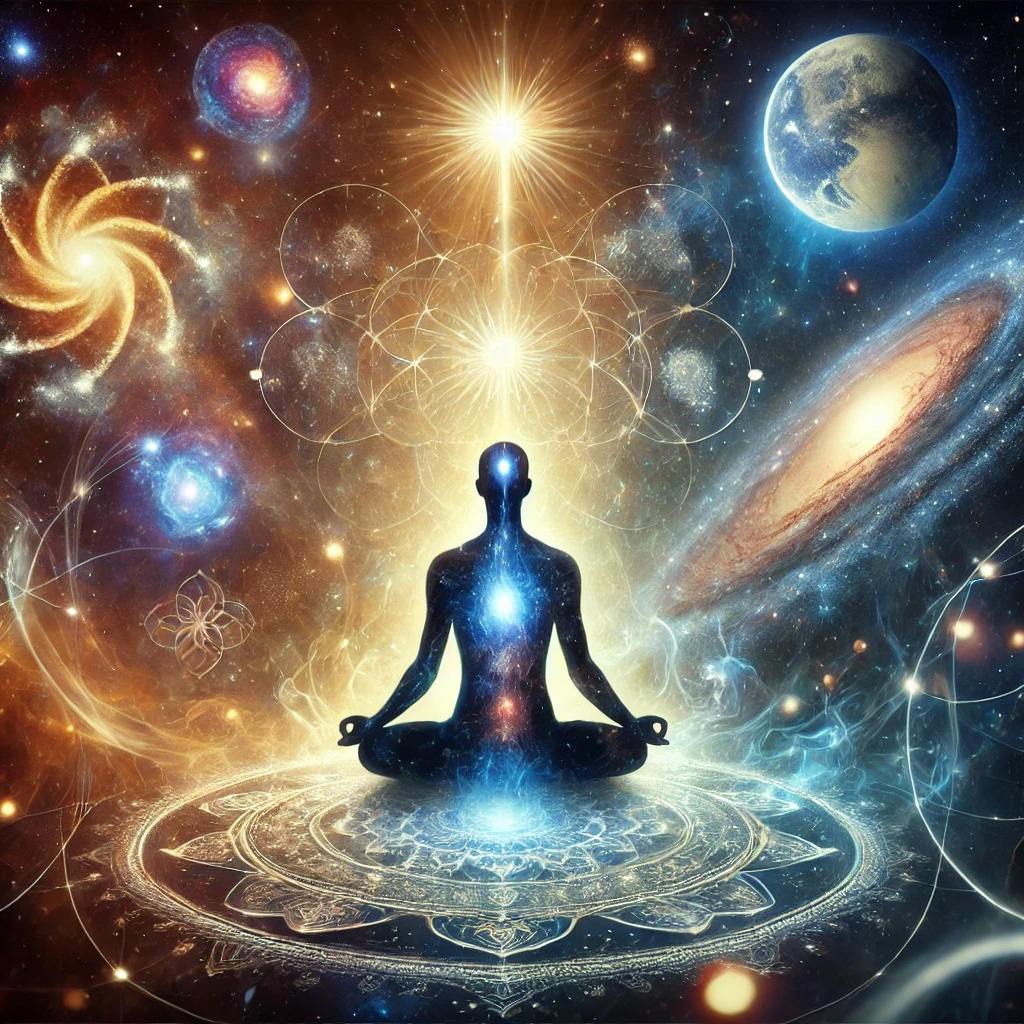
I see each soul not as potentially divine, but as already divine, expressed through finite physical forms, behaviors, and constraints. We are diverse manifestations of One.
What differs among us is not divinity itself, but:
- Biological embodiment
- Psychological development
- Cultural conditioning
- Social consequences
It is through these filters that divinity finds expression in lived life.
The One, the Many, and the Limits of Human Knowing
Across science, philosophy, and spirituality, there appears a recurring intuition: all that exists emerges from One.
In mathematics and physics, the idea of a singularity—a unified whole that can be infinitely fractioned without losing its essential unity—has guided generations of thinkers. Einstein and others pursued fragments of reality, fully aware that scientific models do not capture reality itself, but only what the human mind can organize and measure through mathematical abstractions, later subjected to experimental validation.
Immanuel Kant gave philosophical structure to this insight by distinguishing between:
- Phenomena: the world as it appears to us, structured by the categories of the human mind. These categories themselves evolve across species, shaped by neurological architecture and modified over time through Darwinian adaptation in response to environmental demands.
- Noumena: reality as it is in itself—the Ultimate Reality that lies beyond direct human knowing, unknown and unknowable.
Science advances rigorously within the phenomenal world. Yet it quietly acknowledges its limits—whether in the mysteries of dark matter and dark energy, presumed to constitute about 96% of the universe, in contrast to the roughly 4% of baryonic matter known to us. In this sense, science does not negate spiritual intuition; it delineates its own boundaries.
Scientific reasoning and spiritual belief may thus coexist within us in a compartmentalized way, each operating with different criteria of validity—science grounded in logic and experiment, spirituality appealing to human longing, meaning, and connection with Ultimate Reality.
Religious Language as Existential Orientation
Religious traditions have long spoken of unity using symbolic language rather than empirical claims.
My father, A. A. F. Mohi, wrote in his poem Life and Death:
“Verily, to God we belong and to God we return.”
This Qur’anic expression does not function as a scientific explanation, but as an existential orientation—a way of situating human life within a larger, incomprehensible whole. Similar intuitions appear in Vedanta, Christian mysticism, and Jewish thought: origin and return, not as physical locations, but as meaning.
Life, as we experience it, may not be ultimate reality, but a phase of existential expression, one of many phases through which reality unfolds.
I often visit the grave of our only child, who passed away recently at the age of 54. When I stand there, I do not feel sadness so much as a quiet joy—an inner sense that my body is vibrating more closely with his. Perhaps this is best understood metaphorically, perhaps through the language of quantum entanglement, where elements separated by time and space remain mysteriously correlated. Our shared lived experiences seem to intensify this sense of connection, allowing memory, love, and spirituality to converge beyond physical absence.
Harmony as the Ground of Morality
Moral standards—debated for centuries by philosophers, poets, religious thinkers, and spiritual leaders—do not arise in abstraction. They emerge from the human need for harmony:
- Harmony between body and mind
- Between individual and community
- Between inner values and cultural norms
Different societies articulate morality differently, yet all moral systems attempt—imperfectly—to preserve coherence and reduce destructive disturbance.
This understanding avoids two extremes:
- Moral absolutism, which ignores context and embodiment
- Moral relativism, which denies consequence and responsibility
Instead, morality becomes relational, contextual, and consequence-aware, grounded in lived reality rather than metaphysical certainty.
Dostoyevsky’s Moral Struggle: A Necessary Tension
I first read Fyodor Dostoyevsky’s novels in English translation while studying philosophy some seventy years ago and have revisited his writings from time to time. Few writers have grappled more painfully with questions of morality and the necessity of belief than Dostoyevsky, particularly in The Brothers Karamazov.
Ivan Karamazov, the intellectual brother, confronts the unbearable reality of innocent suffering and asks:
If there is no God and no immortality, is everything permitted?
Dostoyevsky feared that without transcendence:
- Morality would collapse into nihilism
- Freedom would become unbearable
- Authority would replace conscience
Implicit in Dostoyevsky’s struggle is a deeper claim: whether God created humanity or humanity created God may be philosophically unresolved, yet existentially secondary—for human beings appear to need God as a moral and psychological anchor
A Quiet Answer Dostoyevsky Leaves Open
Yet within the same novel, Dostoyevsky offers another path through the youngest brother, Alyosha, who is studying to be a monk, and his mentor, Elder Zosima:
- Compassion without proof
- Responsibility without metaphysical closure
- Faith as lived goodness, not explanation
My reflection aligns more closely with this quieter path.
Rather than demanding noumenal justice, it accepts noumenal mystery. Morality operates within the phenomenal world—guided by consequence, relationship, and harmony—without claiming to justify cosmic suffering.
Life is lived ethically not because ultimate answers are known, but because coherence must be preserved here and now, guided by inner values, a search for harmony within oneself, and an awareness of social consequences—to oneself, to those we love, and to the people around us.
.
Closing Reflection
We may have come from One, and we may return to One—but what lies beyond remains unknown, though often surmised as a different level of existential reality, guided by our respective faiths and values.
Life, then, is not a test with known answers, nor an illusion without consequence.
It is a phase of expression, lived between unity and mystery—where humility, compassion, coherence, awareness of social norms and consequences, and love and respect for those we value guide us, together with the faiths and values that humans across cultures practice and believe in, even when they do not easily submit to logical discourse.
- #ExistentialThoughts
- #UnityAndMeaning
- #ScienceAndSpirituality
- #MoralReflection
- #LimitsOfKnowing
- #HumanHarmony
- #Dostoyevsky
- #PhilosophyOfLife

 Existential Thoughts and Ruminations