There is something deeply restorative about stepping into the woods for a session of nature bathing (Shinrin-yoku). As you take a breath under the canopy—exchanging carbon dioxide for oxygen—it’s easy to feel the quiet balance that holds the natural world together.
During a recent walk, a few connected ideas started coming together about how nature, science, and human understanding intersect.
1. The Invisible Communication Networks of Forests
If you’ve watched recent nature documentaries like Enchanted Forest or similar titles in any Internet channels, you’ve seen how alive and interconnected forests truly are. Trees don’t exist in isolation:
Underground Networks: Trees communicate and trade nutrients via complex fungal networks (often dubbed the “Wood Wide Web”).
Ecosystem Harmony: Plants rely on birds, insects, and soil microbes for pollination and soil health. Some ecosystems even use controlled wildfires to prompt seed germination and regenerate stronger growth.
2. The Inner Ecosystem: Our Microbiome
Just as forests rely on micro-organisms, so do our bodies. Scientists now know our bodies are home to roughly 38 trillion microbes—a near 1:1 ratio with our own cells.
This vast inner ecosystem (the human microbiome) is full of neutral and beneficial organisms. Modern medical research is shifting toward nurturing these helpful microbes while selectively targeting harmful pathogens, paving the way for targeted treatments in immunology and oncology.
3. Nature as the Original Laboratory
Many of our standard pharmaceuticals—from aspirin (derived from willow bark) to key cancer treatments—were first discovered in plant chemistry before being synthesized for medicine.
Whether viewed through the lens of modern science or spiritual tradition, humanity rarely invents fundamental solutions from scratch. Instead, we discover the elegant systems that already exist around us. Nature has been testing and refining these mechanisms for millions of years; our job is simply to observe, learn, and live in balance with them.
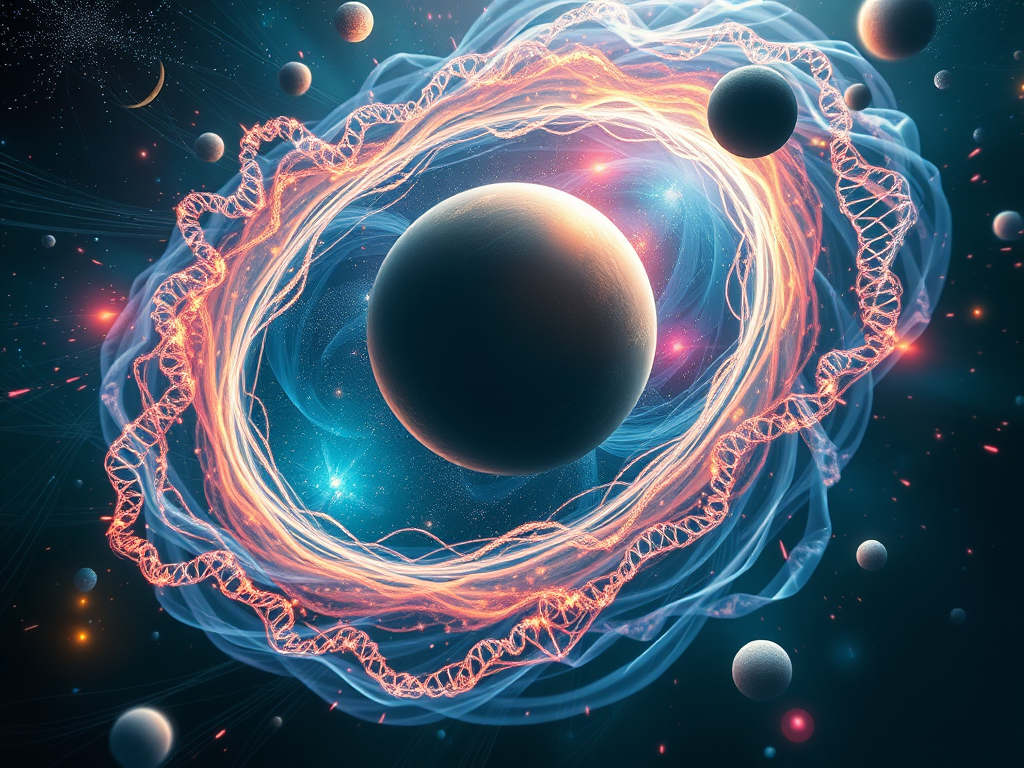
In both the vast cosmic expanse and the minutest particles of matter, movement is an ever-present force shaping reality. The physical world as we perceive it is not static but a dynamic tapestry of continuous motion. On a macroscopic scale, celestial bodies such as planets, stars, and galaxies traverse immense distances, governed by gravitational and relativistic forces. Their intricate orbits and cosmic interactions define the structure of the universe itself. Conversely, at the microscopic level, the ceaseless dance of atomic and subatomic particles forms the foundation of all matter. Electrons orbit nuclei, protons and neutrons interact within atomic cores, and elementary particles recombine to generate the physical and chemical properties that dictate the laws of nature. These unseen movements underscore the fundamental interconnectedness of all existence, revealing that stillness is merely an illusion.
Movement as the Essence of Life encompasses a vast array of activities that characterize existence in both the physical and metaphysical realms. It highlights the innate drive to evolve and adapt, urging individuals to embrace change as a natural part of their journey. Every heartbeat, every breath, represents a dynamic exchange between the body and the environment, signifying growth and transformation. From the minute movements of cells to the grandest migrations of species, movement reveals the interconnectedness of all life forms. By understanding and appreciating this fundamental principle, individuals can cultivate a deeper connection with themselves and the world around them, ultimately leading to a more fulfilling and enriched experience of life.
Living organisms embody this universal principle of motion through both observable and concealed processes. The movements of limbs, locomotion, and other gross physical actions represent only a fraction of the activity within biological systems. Beneath the surface, an intricate web of biochemical and bioelectrical mechanisms propels life forward. Cellular and intracellular processes, such as molecular signaling, metabolic pathways, and neural activity, sustain vitality, enabling growth, repair, and reproduction. Even at the level of DNA, molecular machinery orchestrates replication, transcription, and translation, ensuring the continuity and adaptation of life itself.
Earth’s Perpetual Motion: Geological and Evolutionary Shifts
Despite its apparent stillness, the Earth itself is in constant motion. The planet rotates on its axis, revolves around the Sun, and is subject to the gravitational influences of other celestial bodies. Beneath its surface, the movement of tectonic plates drives geological transformations, giving rise to earthquakes, mountain formation, and continental drift. These slow yet persistent forces sculpt the landscape over millennia, demonstrating the inescapable dynamism of our world.
Similarly, evolutionary processes reflect another profound form of movement. Fossil records, genetic mutations, and carbon dating reveal how living organisms adapt to ever-changing environments. Evolution is an ongoing interplay between organisms and external forces, an intricate dance of survival, growth, and adaptation. Environmental shifts—whether gradual or abrupt—act as catalysts for evolutionary change, compelling species to adjust, innovate, or perish. This process is a testament to movement not only in a physical sense but also in terms of transformation and progression.
Human Experience: Social and Psychological Motion
As sentient beings, humans are immersed in this universal rhythm of movement, navigating both physical and social landscapes. Throughout history, migration, exploration, and cultural exchange have defined human civilization. From early hunter-gatherers traversing continents to modern migratory patterns driven by economic, political, and environmental factors, movement has shaped societies, economies, and interactions between cultures.
This behavior mirrors the migratory patterns observed in the animal kingdom, where movement in search of food, shelter, and survival is fundamental to existence. Whether seasonal migrations of birds or the strategic foraging of insects, adaptation through mobility is a universal trait.
Yet movement extends beyond the physical; it is embedded in human thought, innovation, and emotional experience. Social structures evolve, ideologies shift, and personal identities transform over time. The human mind itself is a landscape of constant motion, processing memories, emotions, and aspirations. This psychological movement defines personal growth, learning, and the evolution of consciousness.
The Inevitable Flow of Time and Entropy
Beyond biological and social movement, the passage of time itself is an inescapable form of motion. Thermodynamic principles dictate a unidirectional flow from order to disorder, emphasizing the impermanence of all structures. Entropy ensures that all systems eventually degrade and transform, reinforcing the idea that change is the only constant.
Einstein’s theory of relativity further expands our understanding of this relationship between movement, time, and space. According to relativity, the perception of time is intricately tied to the rate of motion through space. Space-time, as a unified dimension, reveals that movement and time are not independent phenomena but interconnected aspects of a greater cosmic reality. The faster an object moves relative to an observer, the more time dilates, reinforcing the profound interrelationship between motion and temporal experience.
Existential Implications of Movement
Uniquely, human beings possess the ability to anticipate and shape the future based on accumulated knowledge, cultural understanding, and technological advancements. This foresight enables planning, creativity, and innovation, but it also brings an acute awareness of mortality. The unpredictable nature of existence fosters a deep-seated existential uncertainty—an awareness of impermanence that influences human thought and behavior.
To cope with this existential reality, civilizations throughout history have developed belief systems, philosophical doctrines, and creative expressions. Religious and spiritual traditions provide frameworks for understanding life and death, while artistic and intellectual pursuits offer outlets for self-expression and meaning making – creative endeavors, from literature and music to scientific discovery, which serve as ways for individuals to navigate their transient existence and leave imprints on the world, countering the relentless march of time.
Embracing the Existential Movement
In essence, movement—be it physical, biological, social, or existential—is the defining characteristic of reality. It underlies the structure of the universe, the behavior of living organisms, and the trajectory of human history. From the cosmic dance of galaxies to the microscopic interplay of atoms, from evolutionary shifts to the migrations of civilizations, everything is in flux.
To truly understand and embrace this fundamental truth is to recognize the profound interconnectedness of all things. It is to see ourselves not as isolated entities but as integral participants in a vast, dynamic, and ever-evolving cosmos. By aligning ourselves with the natural rhythms of motion and change, we can navigate the complexities of life with greater adaptability, purpose, and wisdom. This alignment allows us to flow with the currents of existence, fostering a sense of harmony that is uniquely suited to our momentary place in the grand tapestry of reality.