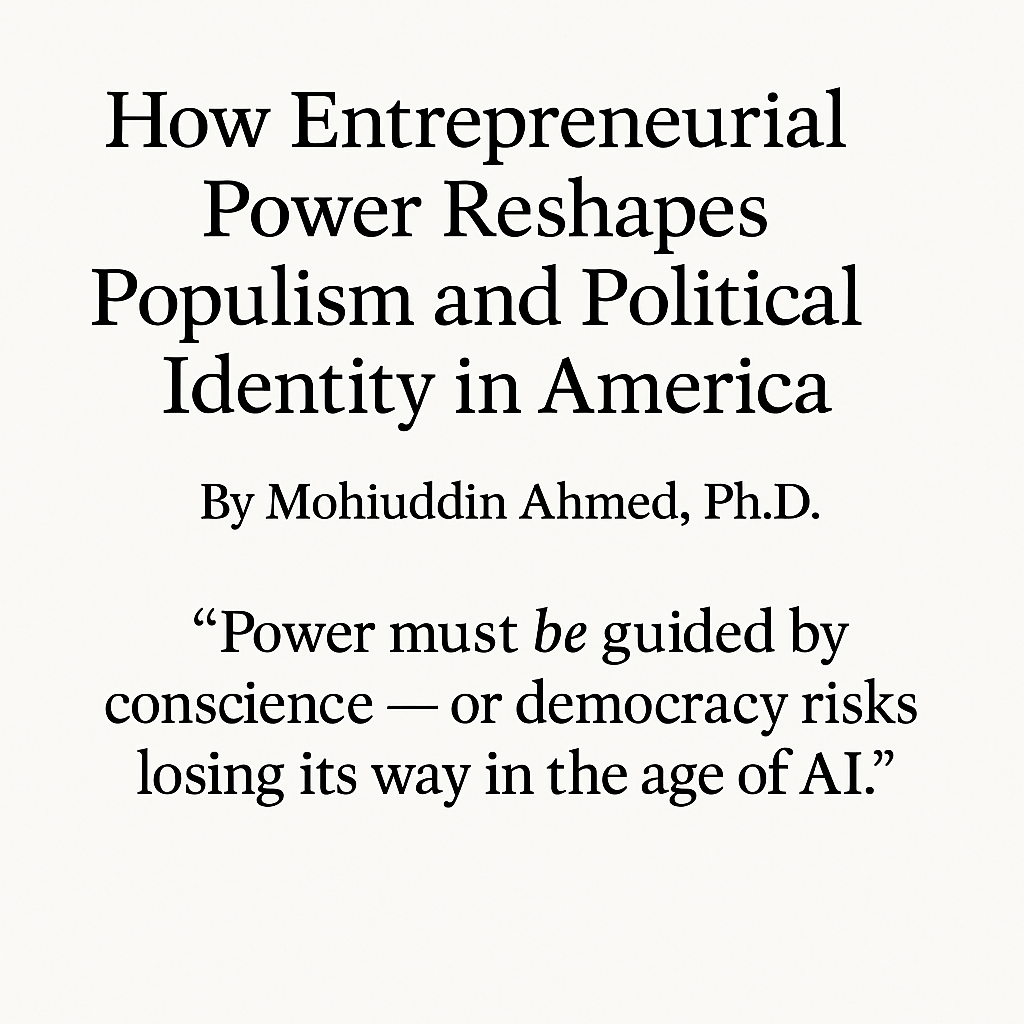
Contemporary Reflections: Entrepreneurs, Business Power, and Political Strategy

Introduction: When Business Meets Politics

A growing phenomenon in American life reveals that entrepreneurs are no longer content to remain behind the scenes. They are entering politics not merely as donors but as designers of policy—reshaping how the nation defines success, fairness, and identity.

This shift helps explain a critical question of our time: Why does MAGA-style populism retain such emotional and cultural appeal?

Beneath the slogans lies a strategic alliance: entrepreneurial elites seeking to shape the economic framework of the nation, and working-class citizens yearning for dignity, stability, and purpose. Together, they are redefining modern populism and the very meaning of political power.

Politics as an Extension of Business Strategy

Entrepreneurs understand that innovation alone cannot secure success. The ecosystem in which business operates—taxation, trade, labor laws, regulation, and cultural norms—is equally decisive.

Political participation has therefore become a logical extension of business strategy. By influencing policy, business leaders create not only favorable markets but also a cultural climate aligned with their values and vision of progress.

This is no longer traditional lobbying. It represents a systemic evolution—from competing within the market to shaping the rules that govern it.

A Convergence of Interests

The populist promise to “bring jobs back” resonated with two constituencies that once saw themselves as worlds apart.

For business elites, it suggested deregulation, lower taxes, and renewed domestic production.
For workers, it evoked dignity, pride, and the restoration of meaning to work and community.

This unlikely partnership has produced a new form of economic nationalism—pragmatic, emotionally charged, and fiercely identity-driven.

From Campaign Donors to Policy Architects

Today’s entrepreneurs—from Elon Musk and Larry Ellison to Peter Thiel and other influential digital and industrial innovators—no longer limit themselves to markets. They have become architects of public policy, shaping debates over energy, trade, technology, freedom, and the nation’s future direction.

Politics itself has become an advanced form of enterprise management, where success is measured not only in profit or votes but in the power to define values, narratives, and long-term purpose.

Global Reflection: Why Populism Feels Different Across Nations

In recent weeks, while watching documentaries on Siberia and Russia and reading History magazine on Libby, I developed a renewed appreciation for the cultural and psychological depth of reverence for centralized authority in Russian society.

This reverence persists even when authority becomes despotic. It reflects centuries of harsh geography, spiritual traditions, national mythology (“Mother Russia”), and collective memory that Western analysts often overlook.

This pattern extends across many regions: Afghanistan, the Middle East, parts of Africa, and numerous post-colonial societies. Populist causes there cannot be understood through Eurocentric ideals alone.

Here in the United States, democratic traditions run deep, and the political pendulum swings back and forth with relative stability. But in Russia, North Korea, Afghanistan, and similar nations, Eurocentric assumptions do not easily apply.

Many of us raised in Western-style educational traditions—often representing a small, elite minority shaped by colonial histories and blended identities—were taught to view liberal democracy as a universal model. Today, it is clearer than ever that it is not universally transferable.

The Moral Question: What Should Guide Power?

All of these dynamics bring us back to a timeless philosophical question: To what end is power exercised?

Throughout history, civilizations have been shaped by control over land, production, and trade. Today, the primary resource is policy itself—and those who shape it influence both material outcomes and the moral direction of society.

Transactional pursuits sustain life, but idealism sustains civilization.

Idealism—grounded in democratic principles, universal spiritual values, and expressed through diverse religious traditions—affirms equality, justice, the dignity of the individual, and our yearning for connection with a Universal Force that transcends personal circumstance.

A healthy society requires balance between pragmatic interest and ethical purpose, nationalism and global belonging, sovereignty and solidarity, material ambition and spiritual continuity.

Human history swings like a pendulum through these tensions. Leadership—corporate, political, intellectual, and technological—must ensure that power remains guided by principle and that prosperity serves human dignity.

AI and the New Struggle Over Truth

The convergence of entrepreneurial influence, populist identity, and modern media has now been magnified by a powerful new force: AI.

AI can illuminate truth—or blur it. Its ability to generate highly refined narratives, emotionally appealing arguments, and persuasive messages makes it a potential tool for deeper understanding—or sophisticated propaganda.

This reality demands a new level of reflective judgment from citizens, leaders, educators, and institutions. We must learn not only to evaluate content but to question how and why it was generated.

AI challenges us to engage our conscience more urgently than ever.

Conclusion: A Call for Ethical Leadership

We stand at a pivotal moment.

The fusion of entrepreneurial power, populist emotion, global identity struggles, modern media, and AI-driven narratives is reshaping democratic life.

If guided by vision and conscience, these forces can redirect innovation toward the common good. If driven by ambition and manipulation, they may deepen inequality, distort reality, and weaken democratic trust.

True progress requires the integration of intelligence with conscience—aligning creativity, technology, and ethical purpose.

In an age increasingly shaped by AI, this alignment is not optional. It may determine the fate of democracy itself.


Related Readings


Hashtags for Cross-Platform Sharing

.#Entrepreneurship
#Populism
#PoliticalStrategy
#AIandSociety
#EthicsInLeadership
#MoralLeadership
#AmericanIdentity
#ExistentialPerspectives
#Democracy
#MediaPsychology
#Advertising
#Globalism
#PoliticalIdentity
#UniversalHumanity
#PublicPolicy


Science, Spirituality, and the Immune System: A Psychobiological Existential Reflection

Science, Spirituality, and the Immune System: A Psychobiological Existential Reflection

By Mohiuddin Ahmed, Ph.D.
Retired Clinical Psychologist with over 40 years of practice experience and early academic training in Philosophy. Actively engaged in mental-health writing, publication, and blogging.


Introduction: The Meeting of Two Lenses

This reflection was prompted by reading Alessandro Sette’s First Person essay in the November–December 2025 issue of American Scientist, in which the author described the lifelong curiosity that drives his research on the immune system. His account awakened in me a recognition that science and spirituality, though often seen as separate, are both expressions of the same search for coherence and meaning in life.

Further inspiration came from Eric Topol’s writings on longevity, digital medicine, and the biology of aging, which sharpened my appreciation of how scientific progress is reshaping our understanding of health across the lifespan. Equally formative was Siddhartha Mukherjee’s The Emperor of All Maladies, a work I have read twice, whose exploration of cancer as both a biological and historical phenomenon deepened my reflections on immunity, cellular regulation, and the fragile intelligence of life itself. While I have only browsed The Song of the Cell, its themes remain relevant to this broader inquiry into how cells communicate, defend, and sometimes betray the organism they serve.

These scientific narratives resonate with my earlier intellectual formation. During my graduate training in clinical psychology at the University of Pittsburgh, my engagement with Freud’s foundational ideas—particularly the dynamics of conflict, regulation, and the failure of control—was complemented by readings in psychoanalytic theory, including Fenichel’s The Psychoanalytic Theory of Neurosis, which emphasized systemic balance, breakdown, and adaptation. Long before these clinical encounters, my academic grounding in philosophy at the University of Dhaka, especially Kantian philosophy, shaped my enduring interest in how mind, body, and moral judgment organize human experience.

More recently, popular science has continued to feed this integrative perspective. I was particularly struck by the chapter “Life Organizing the Atoms” in Nigel Henbest’s The Exploding Universe, which poetically frames life as an emergent ordering principle within the cosmos. Together, these scientific, psychoanalytic, and philosophical influences reinforce a central conviction of this essay: that the immune system and the human psyche reflect parallel struggles involving information processing, boundary recognition, balance, and meaning within a living entity striving for optimal adaptation—and that scientific insight, metaphysical reflection, and spiritual wisdom need not compete, but can illuminate one another in our ongoing effort to understand what it means to be human.

Modern science and timeless spirituality are not opposing worldviews but complementary ways of knowing. Both explore how life sustains itself—through the immune system’s biological vigilance and through the human spirit’s enduring search for harmony.

1. The Immune System and the Human Condition

The immune system is a remarkable defense network, constantly distinguishing between what belongs to us and what does not. Antibodies identify and neutralize foreign invaders before illness begins, while T-cells target and destroy those that have already entered and caused harm.

Yet this intricate system can fail in two opposing ways:

  • Cancer — the immune system fails to recognize its own cells turning malignant, allowing them to multiply unchecked.
  • Autoimmunity — the system mistakes healthy cells for enemies, attacking the very body it is meant to protect.

Both breakdowns reflect a disturbance in the boundary between “self” and “non-self.” In this sense, the immune system’s challenges echo the human condition: we struggle, individually and collectively, to discern what truly threatens us and what we merely misperceive as danger.

2. Echoes of Evolution

From an evolutionary perspective, this pattern reflects our biological origins. Primitive single-celled organisms that existed billions of years ago behaved much like cancer cells—endlessly multiplying, seemingly immortal, without the regulation and cooperation we see in complex organisms today.

As Earth’s chemistry evolved, multicellular life emerged, bringing specialization, collaboration, and programmed cell death. These developments allowed for higher-order functioning and continuity of life through genetic transmission. Yet those primitive tendencies still reside within us. When suppression mechanisms fail—due to factors not yet fully understood—dormant cancer cells may re-emerge, creating dysfunction and, ultimately, death.

3. The Psychological Parallel

The same evolutionary story unfolds in the realm of the mind. Freud’s concepts of the id, ego, and superego reflect a similar movement from primitive impulse to regulated behavior. The id represents raw, instinctive drives; the ego and superego develop later to restrain and channel these impulses toward social harmony and moral order.

In this sense, both body and mind follow parallel paths—from unrestrained expansion to disciplined balance. Just as mature cells restrain primitive cellular rebellion, the conscious mind disciplines instinct through reflection, reason, and morality. When this balance is lost, psychological distress or maladaptive behavior emerges, mirroring the immune system’s loss of healthy control.

4. Beyond the Traditional: The Quantum Turn

If cancer is not merely an external enemy but an internal echo of our evolutionary past, then lasting solutions may require more than the traditional “cut, burn, and poison” methods of surgery, radiation, and chemotherapy.

An emerging frontier involves integrating molecular biology, immunology, and genetic engineering with the power of quantum computation. Quantum-informed modeling may one day help us understand each person’s unique “immune signature” at a level of complexity that surpasses current methods. This could open the way to more precise and individualized treatments—maximizing benefit while minimizing harm.

5. Quantum Entanglement and Spiritual Connection

Quantum science also opens an unexpected bridge between science and spirituality. Concepts such as quantum entanglement suggest that particles, once linked, can remain connected across vast distances. Past, present, and future interactions may be woven together in ways the human mind can only partially grasp.

Spiritual traditions have long spoken of a similar unity—an invisible bond among all beings and between the living and the dead. When I visit the grave of our only child, who died of cancer at age 54, I often feel that my body vibrates in resonance with his remains beneath the earth. It is as though our shared experiences, love, and memories continue to connect us beyond space and time.

Science may call this an imaginative experience or look for explanations in quantum theory; faith may call it spiritual unity. For me, both perspectives point toward the same underlying reality: connection that transcends ordinary measures of distance and time.

6. Allergies and Misattribution: Body–Mind Parallels

Allergies provide another window into misdirected defense. In allergic reactions, the immune system attacks harmless substances—pollen, dust, certain foods—as if they were dangerous invaders. The system confuses friend with foe.

This has a psychological parallel. In states of anxiety, trauma, or paranoia, the mind may perceive hostility or threat where none actually exists. Neutral comments, everyday interactions, or ambiguous expressions can be experienced as dangerous. In both allergy and psychological misattribution, confusion arises at the boundary between safe and unsafe, self and other.

These analogies highlight the importance of restoring clarity and balance in our self-regulatory systems. In clinical practice, many therapeutic models seek to address this confusion. One approach I have developed, Mind Stimulation Therapy (MST), combines awareness, mindfulness, cognitive stimulation, and positive redirection. It encourages individuals to recalibrate perception, movement, and thinking toward more adaptive and integrated functioning.

7. The Singularity and the Supreme Being

On the cosmic scale, we encounter similar metaphors of unity. Cosmologists speak of a Point of Singularity at the origin of the universe—a state in which all matter, energy, space, and time were compressed into one. Many spiritual traditions speak of God, the Supreme Being, or a universal consciousness as the source from which all creation flows and to which it ultimately returns.

Science seeks to explain how life exists: the mechanisms of cells, genes, and immune responses. Spirituality seeks to reveal why life exists: the purpose, value, and meaning behind our experiences of joy, loss, growth, and mortality. When viewed together, they offer two lenses focusing on a single truth—that life, death, and continuity are interwoven expressions of an underlying unity.

8. Toward Tolerant Coexistence

Our collective task is not to choose between science and spirituality but to allow them to inform and enrich one another. Respecting diverse beliefs—while honoring empirical knowledge—may guide humanity toward greater tolerance, understanding, and peace.

Across traditions and disciplines—religious, scientific, philosophical, and cultural—each offers meaningful ways to cope with the Known, the Unknown, and the Unknowable. All our scientific pursuits and spiritual longings ultimately converge on a shared insight: we are diverse expressions of a single, interconnected reality, bound together in origin and destiny.


#Tags / Hashtags:

ExistentialPerspectives #ScienceAndSpirituality #PsychobiologicalReflection
#MindBodyConnection #Immunology #CancerResearch #LongevityScience
#Psychology #PsychoanalyticTheory #Freud #PhilosophyOfMind
#KantianPhilosophy #HumanConsciousness #InformationProcessing
#SystemsBiology #HolisticPerspective #MeaningMaking #UnityOfKnowledge


Mohiuddin Ahmed, Ph.D.
Retired Clinical Psychologist with over 40 years of practice experience and early academic training in Philosophy. Actively engaged in mental-health writing, publication, and blogging.


Creativity as Cosmic Discovery


Potential for Creativity and Cosmic Memory Are Embedded in All of Us

The potential for creativity lives within all of us to varying degrees. It is not limited to the few we call artists, inventors, or visionaries. Rather, it is a birthright, endowed to every human being with differing capabilities shaped by individual circumstances, and expressed according to the availability of communication technology, education, and learning opportunities within diverse cultural conditions.

Creativity is a process of discovery—of uncovering what already exists within us

Plato described a world of Ideas or Forms—a realm of pure, unchanging truths that reflect the real world, representing the ideal forms of objects we perceive within the mind (Plato, Republic, ca. 375 BCE). When we create, we do not merely invent; we tap into these visions of ideal forms, bringing fragments of them into our lived reality. Spinoza later theorized that the world is like a universal clock, set to run its own course and rhythm—one that humanity can glimpse through mathematics and philosophical reasoning (Ethics, 1677). Immanuel Kant, building on this lineage, argued that certain truths are known a priori, already present in the mind before experience—such as time, space, and causality (Critique of Pure Reason, 1781). These innate structures shape how we interpret reality and create meaning. This resonates with the age-old proverb, “Know thyself,” in the pursuit of wisdom.

Scientific discoveries, in my view, often affirm these ancient intuitions. For example, through advanced genetic testing of fossilized bones, researchers are uncovering detailed information about humans and animals who lived millions of years ago (Pääbo et al., 2022, Nobel Prize in Physiology or Medicine). In these remains, molecular memory is preserved—telling stories of migration, diet, adaptation, and even relationships. These findings reveal a profound truth: memory is embedded in matter, and the past lives on in the present, quietly guiding the process of discovery.

Neuroscience, as described in popular science, suggests that our brains are wired for creativity—we generate patterns, imagine futures, and remember symbolically (Kandel, 2018; Sacks, 2019). Yet this process is not isolated. Across cultures and generations, there exists a sense of shared knowing—a cosmic memory embedded within all of us, which some might call ancestral memory, soul memory, or the collective unconscious (Jung, 1968). Whatever its name, it remains a source from which, perhaps, our creativity draws meaning.

Suggested Readings

  • PlatoThe Republic (ca. 375 BCE). A foundational work exploring justice, knowledge, and the realm of ideal Forms.
  • Baruch SpinozaEthics (1677). A vision of the universe as a rational, ordered whole, governed by unchanging laws.
  • Immanuel KantCritique of Pure Reason (1781). A deep examination of how the mind shapes experience through innate categories.
  • Svante PääboNeanderthal Man: In Search of Lost Genomes (2014). Nobel Prize–winning work on ancient DNA and the stories hidden in fossil remains.
  • Eric R. KandelThe Age of Insight (2018). A neuroscientist’s view on creativity, art, and the workings of the mind.
  • Oliver SacksThe River of Consciousness (2019). Essays on memory, creativity, and the brain’s narrative power.
  • Carl JungThe Archetypes and the Collective Unconscious (1968). Introduces the idea of shared symbols and patterns in human thought.

From One to All, and All to One

All came from One. Modern cosmology tells us that the universe emerged from a single, incomprehensibly dense point—a singularity—from which space, time, energy, and matter unfolded. From that original moment, all things are connected. In this sense, the One is embedded in All, and every particle and being carries the trace of that singular origin. Creativity is the expression of that embedded unity—an echo of the universal unfolding.

This perspective aligns not only with physics and metaphysics but also with many religious and spiritual traditions. Across cultures and faiths, there is a shared belief in an All-Knowing Creator—a divine source, the Almighty, from which all life originates and into which all ultimately returns. Whether called God, or by another sacred name, or simply referred to as the Infinite, this origin is seen as both transcendent (beyond all) and immanent (within all)—the One who dwells in All and reveals through All.

Interestingly, this worldview dovetails with insights from modern quantum theory—particularly the concept of the multiverse and quantum computing—where traditional binaries collapse, paradoxes coexist, and present, past, and future can all exist simultaneously. In such a quantum multiverse, one might glimpse a reflection of the All-Knowing Mind and the Reality of the One, from which all have emerged—a reality many call God—offering a profound testimony to the convergence of scientific discovery and faith-based understanding.

In this way, creativity becomes more than innovation—it is participation in the ongoing act of discovery. It is the human spirit attuning itself to the cosmic or divine rhythm, discovering truths already sown into the fabric of the cosmos.

Suggested References

  1. Hawking, S. (1988). A Brief History of Time. Bantam.
  2. Greene, B. (2011). The Hidden Reality: Parallel Universes and the Deep Laws of the Cosmos. Knopf.
  3. Rovelli, C. (2017). Reality Is Not What It Seems: The Journey to Quantum Gravity. Riverhead Books.
  4. Capra, F. (1999). The Tao of Physics: An Exploration of the Parallels Between Modern Physics and Eastern Mysticism. Shambhala.
  5. Penrose, R. (2010). Cycles of Time: An Extraordinary New View of the Universe. Knopf.
  6. Barbour, J. (1999). The End of Time: The Next Revolution in Physics. Oxford University Press.
  7. Chalmers, D. J. (1996). The Conscious Mind: In Search of a Fundamental Theory. Oxford University Press.

You can explore more reflections like this at ExistentialPerspectives.com and learn about therapeutic applications through MindStimulationTherapy.com—both dedicated to honoring human potential and the universal movement toward well-being.


#ExistentialPerspectives #CreativityAndConsciousness #PlatoAndForms #KantianPhilosophy #SingularityToSelf #CosmicMemory #FossilDNA #EmbeddedWisdom #MindStimulationTherapy #MindBodySoul #SpiritualScience #HumanExperience

Grief, Quantum Physics, and Eternal Spirit

The following message is adapted from a deeply personal letter I wrote to my daughter-in-law in response to the eulogy she delivered at the memorial service for our only child, who passed away from cancer.
Although I could not attend due to hospitalization, I was deeply moved by her words and felt compelled to record my own thoughts—rooted in personal grief and lifelong philosophical reflection. My aim was not only to share them with her but also with the wider community, hoping they might resonate with others who have endured loss.

This expression weaves together faith-based beliefs from many traditions and science-based understandings of the cosmos, particularly through the lens of quantum physics, as I have come to know from popular science readings, my background in philosophy and clinical psychology, decades of professional practice, and personal spiritual reflections enriched by poets and thinkers.

“…While standing beside my son’s grave, memories flooding in, I feel my body vibrate with his presence—as quantum entanglement suggests, linked at the micro-electrical levels of our existence—a connection deepened through our lived experiences together. Just as entangled particles reflect each other’s state instantly across distance, I believe that deep emotional and spiritual bonds endure beyond physical separation. Love, shared experiences, and presence form invisible threads—quantum echoes of eternal connection—mirroring spiritual beliefs in unity within the realm of the One.

This idea—of love and presence transcending form—appears in the poetry of Rabindranath Tagore, Nobel laureate and philosopher-poet of Bengal. As a child, I came to love and memorize his poems, and I often listen to his songs while driving. In Jokhon Porbe Na Mor Payer Chinho Ei Bate (“When My Footprints No Longer Mark This Path”), he writes:

When my footprints will no longer mark this path,
I will have left behind name and form and gone afar—
Yet I shall return again and again, in new names,
In fresh forms—carrying the same eternal self.

Rumi, the 13th-century Persian Sufi mystic, whose work I came to appreciate more deeply through my association with your Azeri-Iranian father, affirms:

“Don’t grieve. Anything you lose comes round in another form.”

“Goodbyes are only for those who love with their eyes.
For those who love with heart and soul, there is no separation.”

My wife, our son’s beloved Filipino mother, finds solace in her Catholic faith and its promise of eternal life. My father, A.A.F. Mohi, who lived in the Indian subcontinent, offered a Muslim perspective in his poem Life and Death:

“…Man must die,
Await the inevitable moment,
With only consolation in spirit…
Verily to God we belong,
And to Him we return.”

Such beliefs resonate with the Hindu concept of moksha, the Christian hope of resurrection, and the Buddhist understanding of nirvana—the ultimate release from human wants and suffering, and the merging of the soul with the One Ultimate Reality.

The popular Irish ballad “Danny Boy,” which I often listen to—and which your late beloved Irish American mother must have loved—echoes this timeless connection:

“But come ye back when summer’s in the meadow,
Or when the valley’s hushed and white with snow…
’Tis I’ll be here in sunshine or in shadow…”

Across spiritual traditions, there is this shared belief in an enduring, all-pervading consciousness—from which all life emerges and to which it ultimately returns. Whether expressed as the Atman–Brahman unity of Vedanta, the Spiritus Mundi of mystical Christianity, Tawhid in Islam, or Ein Sof in Kabbalistic Judaism, the message is the same: the soul belongs to a greater, eternal Reality of the One, present both within us and all around us. This truth finds echo in the gift hanging I saw on your door the other day—a sign that reads, “Hush, listen carefully, I am around, ” a reminder of our son’s continuing presence.

Some physicists suggest that time itself is not absolute but relational—what we call the “past” may still exist in another form of “now.” Einstein once wrote to the widow of his close friend, Michele Besso, that the distinction between past, present, and future is only a “stubbornly persistent illusion.” In quantum theory, a particle can exist in two states at once, hinting at a multiverse where past, present, and future coexist.

Whether expressed through physics, poetry, religion, or philosophy, one truth endures: love is not limited by time. Our son’s kindness, laughter, and devotion are not lost. His presence—and the memories of all our loved ones—live within us, resonating across both the quantum realm of physical reality and the Eternal Spirit within the Reality of One.

Thank you again for your beautifully expressed tribute. Your words echo the depth of our shared grief and enduring love, reminding us of “the eternal connection” that binds us all. We draw strength from our memories, from one another, and from the many ways our son—your beloved husband, devoted father, cherished family member, loyal friend, and valued presence—lives on: within time, beyond form, and always in spirit, as do the loved ones of all of us…”


#LossAndHealing #SacredConnection #PhilosophyOfLife #Consciousness #AfterlifeConnection #SpiritualContinuity #GriefJourney #QuantumEntanglement #LoveBeyondTime #ScienceAndSoul #InvisibleThreads #MemoryAndPresence #EntangledSouls #Tagore #MysticalPoetry #EternalReturn #Reincarnation #TimelessSoul #RumiWisdom #SoulLove #NoSeparation #UniversalSpirit #SacredContinuum #WorldFaiths #InterfaithWisdom #FaithAndGrief #SpiritualUnity #CatholicFaith #LifeAndDeathPoem #MuslimPoetry #DivineReturn #QuranicWisdom #Moksha #Resurrection #Nirvana #SacredDestiny #SpiritualCycle #ManyToOne #CosmicOneness #PoeticEternity #CycleOfLife #PresenceBeyondForm #NatureAndSpirit #IrishBallads #LegacyOfLove #CelticMemory #PersianPoet #EvolutionOfSoul #RumiOnLife #TimelessLove #SpiritualPhysics #SacredEnergy #NonlinearTime #PhysicsAndTime #SharedGrief #EternalGratitude #UnityInSpirit #HumanExpression #AuthenticReflection #HealingWithWords


Please note, I used (AI) tools for editorial support, including citing hashtags, but the ideas, interpretations, and conclusions expressed are solely my own, and the copyright for the content remains with me as the author, Mohiuddin Ahmed, Ph.D.

The Omnipresence of Movement in the Physical and Cosmic Realms: The Universal Principle Shaping Life, Nature, and Existence

The current image has no alternative text. The file name is: image.png

In both the vast cosmic expanse and the minutest particles of matter, movement is an ever-present force shaping reality. The physical world as we perceive it is not static but a dynamic tapestry of continuous motion. On a macroscopic scale, celestial bodies such as planets, stars, and galaxies traverse immense distances, governed by gravitational and relativistic forces. Their intricate orbits and cosmic interactions define the structure of the universe itself. Conversely, at the microscopic level, the ceaseless dance of atomic and subatomic particles forms the foundation of all matter. Electrons orbit nuclei, protons and neutrons interact within atomic cores, and elementary particles recombine to generate the physical and chemical properties that dictate the laws of nature. These unseen movements underscore the fundamental interconnectedness of all existence, revealing that stillness is merely an illusion.

Movement as the Essence of Life encompasses a vast array of activities that characterize existence in both the physical and metaphysical realms. It highlights the innate drive to evolve and adapt, urging individuals to embrace change as a natural part of their journey. Every heartbeat, every breath, represents a dynamic exchange between the body and the environment, signifying growth and transformation. From the minute movements of cells to the grandest migrations of species, movement reveals the interconnectedness of all life forms. By understanding and appreciating this fundamental principle, individuals can cultivate a deeper connection with themselves and the world around them, ultimately leading to a more fulfilling and enriched experience of life.

Living organisms embody this universal principle of motion through both observable and concealed processes. The movements of limbs, locomotion, and other gross physical actions represent only a fraction of the activity within biological systems. Beneath the surface, an intricate web of biochemical and bioelectrical mechanisms propels life forward. Cellular and intracellular processes, such as molecular signaling, metabolic pathways, and neural activity, sustain vitality, enabling growth, repair, and reproduction. Even at the level of DNA, molecular machinery orchestrates replication, transcription, and translation, ensuring the continuity and adaptation of life itself.

Earth’s Perpetual Motion: Geological and Evolutionary Shifts

Despite its apparent stillness, the Earth itself is in constant motion. The planet rotates on its axis, revolves around the Sun, and is subject to the gravitational influences of other celestial bodies. Beneath its surface, the movement of tectonic plates drives geological transformations, giving rise to earthquakes, mountain formation, and continental drift. These slow yet persistent forces sculpt the landscape over millennia, demonstrating the inescapable dynamism of our world.

Similarly, evolutionary processes reflect another profound form of movement. Fossil records, genetic mutations, and carbon dating reveal how living organisms adapt to ever-changing environments. Evolution is an ongoing interplay between organisms and external forces, an intricate dance of survival, growth, and adaptation. Environmental shifts—whether gradual or abrupt—act as catalysts for evolutionary change, compelling species to adjust, innovate, or perish. This process is a testament to movement not only in a physical sense but also in terms of transformation and progression.

Human Experience: Social and Psychological Motion

As sentient beings, humans are immersed in this universal rhythm of movement, navigating both physical and social landscapes. Throughout history, migration, exploration, and cultural exchange have defined human civilization. From early hunter-gatherers traversing continents to modern migratory patterns driven by economic, political, and environmental factors, movement has shaped societies, economies, and interactions between cultures.

This behavior mirrors the migratory patterns observed in the animal kingdom, where movement in search of food, shelter, and survival is fundamental to existence. Whether seasonal migrations of birds or the strategic foraging of insects, adaptation through mobility is a universal trait.

Yet movement extends beyond the physical; it is embedded in human thought, innovation, and emotional experience. Social structures evolve, ideologies shift, and personal identities transform over time. The human mind itself is a landscape of constant motion, processing memories, emotions, and aspirations. This psychological movement defines personal growth, learning, and the evolution of consciousness.

The Inevitable Flow of Time and Entropy

Beyond biological and social movement, the passage of time itself is an inescapable form of motion. Thermodynamic principles dictate a unidirectional flow from order to disorder, emphasizing the impermanence of all structures. Entropy ensures that all systems eventually degrade and transform, reinforcing the idea that change is the only constant.

Einstein’s theory of relativity further expands our understanding of this relationship between movement, time, and space. According to relativity, the perception of time is intricately tied to the rate of motion through space. Space-time, as a unified dimension, reveals that movement and time are not independent phenomena but interconnected aspects of a greater cosmic reality. The faster an object moves relative to an observer, the more time dilates, reinforcing the profound interrelationship between motion and temporal experience.

Existential Implications of Movement

Uniquely, human beings possess the ability to anticipate and shape the future based on accumulated knowledge, cultural understanding, and technological advancements. This foresight enables planning, creativity, and innovation, but it also brings an acute awareness of mortality. The unpredictable nature of existence fosters a deep-seated existential uncertainty—an awareness of impermanence that influences human thought and behavior.

To cope with this existential reality, civilizations throughout history have developed belief systems, philosophical doctrines, and creative expressions. Religious and spiritual traditions provide frameworks for understanding life and death, while artistic and intellectual pursuits offer outlets for self-expression and meaning making – creative endeavors, from literature and music to scientific discovery, which serve as ways for individuals to navigate their transient existence and leave imprints on the world, countering the relentless march of time.

Embracing the Existential Movement

In essence, movement—be it physical, biological, social, or existential—is the defining characteristic of reality. It underlies the structure of the universe, the behavior of living organisms, and the trajectory of human history. From the cosmic dance of galaxies to the microscopic interplay of atoms, from evolutionary shifts to the migrations of civilizations, everything is in flux.

To truly understand and embrace this fundamental truth is to recognize the profound interconnectedness of all things. It is to see ourselves not as isolated entities but as integral participants in a vast, dynamic, and ever-evolving cosmos. By aligning ourselves with the natural rhythms of motion and change, we can navigate the complexities of life with greater adaptability, purpose, and wisdom. This alignment allows us to flow with the currents of existence, fostering a sense of harmony that is uniquely suited to our momentary place in the grand tapestry of reality.


Migration, Globalization, and Technological Advancements: Conflicts and Evolutionary Adjustments

The current global political and social landscape can be understood as a complex interplay of conflicts and adaptations driven by migration, globalization, and technological advancements. These forces have historically shaped human societies, influencing territorial boundaries, cultural identities, and economic systems. Today, they continue to fuel tensions between protectionist impulses and the ideals of openness, creating a dynamic process of conflict and evolution.

Historical Context: Migration, Territoriality, and Identity

Throughout history, human societies have been shaped by the dual impulses of territorial protection and expansion. From ancient conquests and wars to colonization and trade, migration has been a central force in the redistribution of people, resources, and ideas. These movements have often been driven by the need to secure resources, protect cultural identities, or expand influence. At the same time, they have led to the exchange of goods, knowledge, and traditions, fostering interconnectedness and cultural hybridity.

This behavior mirrors territorial instincts observed in the animal kingdom, where species defend resources critical to survival. However, humans have transcended purely instinctual behavior through the development of civilization, culture, and universal ideologies. Movements advocating for human rights, the emergence of major religions, and the spread of philosophical ideals reflect a growing conviction of unity—a recognition of all people as part of a shared human society. These ideals have promoted diversity and egalitarian principles, emphasizing the inherent rights of every individual to freedom, dignity, and opportunity.

Yet, the realization of these ideals has been uneven. Disparities in economic and social advancement have reinforced divisions, creating tensions between those who benefit from openness and those who feel threatened by it. This tension is not new; it has recurred throughout history, manifesting in cycles of protectionism and openness.

The Dialectic of Protectionism and Openness

The interplay between protectionism and openness can be understood through Hegel’s dialectical framework of Thesis, Antithesis, and Synthesis. In this model, the Thesis represents an established paradigm—such as globalization—while the Antithesis emerges as resistance to it, exemplified by protectionist and nationalist movements. Over time, the interaction between these opposing forces leads to a Synthesis, which reconciles elements of both and propels political and social evolution.

Protectionism—defending territorial boundaries, restricting migration, and limiting trade—often arises from fears of cultural erosion, economic instability, or threats to national security. It reflects a desire to preserve existing identities and systems. Conversely, openness promotes the free exchange of goods, ideas, people, and technologies, fostering interconnectedness and mutual progress. This dynamic tension is a recurring theme in human history, shaping the evolution of societies.

Assimilation and Accommodation: Cultural and Societal Adaptation

Jean Piaget’s theory of Assimilation and Accommodation provides further insight into how societies adapt to the movement of people, ideas, and technology. Assimilation occurs when new experiences are integrated into an existing framework, such as the adoption of foreign technologies or cultural practices. For example, the introduction of new crops, spices, and technologies through trade and migration has often been seamlessly integrated into local economies and cultures.

Accommodation, on the other hand, involves restructuring societal norms and systems to adapt to novel influences. This process is often more disruptive, as it requires fundamental changes to existing structures. For instance, colonization forced indigenous populations to restructure their political, economic, and religious systems, while colonizers themselves often adopted elements of local cultures, creating hybrid systems.

In the modern era, globalization continues to drive cycles of assimilation and accommodation. Immigrant populations introduce cultural practices—such as cuisine, music, and language—that are often assimilated into host societies. Simultaneously, societal structures, such as legal systems, education, and urban planning, undergo accommodation to address the needs of diverse populations. Technological innovations, such as digital communication and artificial intelligence (AI), are also being integrated into daily life, reshaping labor markets, education systems, and governance models.

Tensions and Resistance: The Role of Protectionism

These processes of assimilation and accommodation are not without tension. Resistance often arises when cultural or economic disruptions threaten existing identities or create inequality. Protectionist and nationalist movements seek to slow or reverse these processes, reflecting fears of cultural erosion or economic dislocation. Recent years have seen a resurgence of such ideologies, as evidenced by movements like “Make America Great Again” (MAGA) in the United States and similar nationalist efforts in Argentina, Brazil, and Europe. These movements resonate with populations who feel left behind by globalization, appealing to cultural anxieties and economic grievances.

However, the interconnected nature of globalization—particularly through advancements in technology and AI—makes it unlikely that such movements can fully reverse these trends. Instead, societies are more likely to enter a period of recalibration, balancing openness and protectionism to restore stability. This recalibration aligns with Hegel’s notion of synthesis, wherein a new framework emerges that incorporates elements of both global openness and local protectionism.

Artificial Intelligence: A Catalyst for Dialectical Change

Artificial intelligence exemplifies this ongoing dialectical process. AI accelerates the movement of ideas, knowledge, and innovation, reshaping industries, economies, and cultural exchanges. As AI becomes increasingly integrated into daily life, it reflects societal norms (assimilation) while also driving profound changes in governance, ethics, and labor systems (accommodation). The transformative potential of AI highlights the tension between the opportunities it creates and the challenges it poses, such as job displacement, ethical dilemmas, and misuse. In this sense, AI embodies both the promise of openness and the anxieties that fuel protectionist impulses.

The Path Forward: Synthesis and Evolution

The current era represents a transitional phase in humanity’s evolution. As with past upheavals, the resolution of these tensions will shape political, social, and economic landscapes for decades to come. These trends challenge us to reconsider fundamental questions: How do we balance belonging with inclusion? How do we protect individual rights while fostering collective well-being in an interconnected world? How do we navigate the tension between preserving cultural heritage and embracing inevitable change?

Ultimately, these challenges call for reflection on the deeper implications of movement—whether of people, goods, technology, or ideas—on personal and social well-being. They urge us to reevaluate the principles that underpin modern society, seeking pathways toward a future that honors both the diversity of human experience and the universal aspirations for dignity, opportunity, peace, and harmony that we all share.

In this broader context, the current conflicts and adjustments are not merely disruptions but part of an ongoing evolutionary process. By embracing the dialectical interplay of protectionism and openness, assimilation and accommodation, humanity can navigate these challenges and move toward a more inclusive and equitable future.

Please note: This is one in a series of blog posts by Mohiuddin Ahmed, published under the blog title Existential Perspectives at existentialperspectives.wordpress.com, established in 2014. Unauthorized use and/or duplication of this material without the express written permission of the author is strictly prohibited. Excerpts and links may be used, provided that full and clear credit is given to Mohiuddin Ahmed and Existential Perspectives, along with a direct link to the original content.

Mind-Body-Soul: Thoughts and Reflections

Many believe that the mind is part of a greater entity, the soul—which is thought to exist beyond the physical body as a spiritual essence connected to a Supreme Being or the Ultimate Reality of the Universe. This belief system often provides comfort and guidance when confronting the mysteries of life, death, and the passage of time, including the aging and eventual death of the body. Such religious practices are prevalent as they offer a framework for understanding the unknown and unknowable aspects of existence.

From a scientific perspective, the origins of the universe can be traced to the Big Bang, a singular point of origin approximately 13.8 billion years ago. Everything we observe, physical matter, living organisms, and even the unseen forces like dark matter and dark energy—is considered a manifestation of that singularity. Dark matter and dark energy, although invisible, are hypothesized to play critical roles in shaping and expanding the universe. This scientific narrative aligns conceptually with the religious notion of unity, where all creation originates from a sole source, often symbolized as God or a singular divine entity.

Similarly, the concept of death takes on different meanings across spiritual and scientific paradigms. Religiously, death is viewed as a journey of returning to the divine or the ultimate source of existence. This mirrors the scientific perspective of the natural cycle, where all matter eventually returns to its origins—akin to the cosmological singularity from which the universe began. Both views converge on the idea of interconnectedness and unity, emphasizing that all things are manifestations of one whole.

Such reflections underscore the profound harmony between science and spirituality. While science seeks to explain the mechanisms underlying existence through observation and evidence, spirituality offers a lens to understand the meaning and purpose of that existence. Both perspectives invite us to ponder our place in the grand tapestry of life and the cosmos, suggesting that the boundaries between the physical and metaphysical are less rigid than they might initially seem. Together, they provide a comprehensive framework for navigating the mysteries of being and becoming, of life and beyond.

Note: This writing is by Mohiuddin Ahmed, Ph.D. of his personal existential thoughts and ruminations posted on this website. Unauthorized use or duplication of this material without express written permission is strictly prohibited. Excerpts and links may be used, provided full and clear credit is given to Mohiuddin Ahmed and Mind Stimulation Therapy with appropriate and specific direction to the original context.

Special thanks to AI assistance for enhancing the clarity and structure of this blog post, making the content more accessible and impactful.

Reflections on Time, Perception, and Existence

When I was young, time seemed to stretch endlessly. Waiting—whether for school to end, for playtime to begin, or simply to grow older—felt like an eternity. Every moment was vivid, filled with anticipation and curiosity. And yet, when immersed in play or joy, time felt boundless, as though those moments could last forever.

Now, at the late age decades of my life feel like the blink of an eye, a fleeting flash in the vast expanse of existence. Days, months, and years pass with astonishing speed, slipping through my grasp before I fully register them. This stark contrast in how I have experienced time across my life has led me to reflect deeply on its nature.

Drawing from philosophy and clinical psychology training and professional practice as a psychologist, and my life experiences with recent explorations into popular science, particularly quantum physics, I have come to accept that time is profoundly relative. Einstein’s theories of relativity revolutionized our understanding of time, demonstrating that it is not an absolute, fixed entity but instead depends on movement and perspective. His famous thought experiment involving identical twins offers a compelling illustration: if one twin travels through space at near-light speed while the other remains on Earth, the traveling twin would return younger, having experienced time more slowly relative to the twin on Earth. This phenomenon is not just theoretical; it is a measurable aspect of our universe.

Beyond the grand scale of relativity, I have also considered how biology shapes our perception of time. When we are young, our metabolic rate is faster. This heightened internal rhythm correlates with a slower perception of time—each moment feels rich and expansive. As we age and our metabolism slows, our perception of time accelerates; days feel shorter, years slip by faster, and life, in retrospect, compresses into a series of fleeting memories.

This interplay between biology and perception raises a profound question: Could all living organisms, regardless of their lifespan, experience time similarly? A fruit fly, for example, may live for mere days, while humans typically live for decades. Yet, due to its accelerated metabolic rate, a fruit fly’s perception of those days might feel as lengthy and meaningful as a human’s perception of 80 years. If we frame time as something experienced rather than objectively measured, then the brevity of a fly’s life and the longevity of a human’s might, in some sense, be equivalent in subjective experience.

In this way, time is not just a physical dimension governed by relativity; it is also a deeply personal, biological, and psychological construct. The perception of time arises from a confluence of factors: the external, such as movement and the passage of events, and the internal, such as our biological rhythms and mental states.

As I reflect on my eighty-five plus years of life, I see it not just as a journey through a timeline but as a mosaic of experiences shaped by this dynamic interplay of physics and biology. The young perceive time as expansive because their world is new, their curiosity boundless, and their internal rhythms quickened. The old perceive time as fleeting because their world has grown familiar, their moments are cherished in hindsight, and their internal clocks tick slower. Time is both a universal and deeply personal paradox that binds us all, regardless of how long we live or how we perceive the passing days. It is a reminder to treasure the fleeting moments we have, knowing that in some profound way, they may be infinite in their significance.

Acknowledgments: This writing is inspired by a lifetime of learning and reflection, enriched by my professional experiences in psychology, and early graduate training in philosophy, and influenced by the insights of great thinkers in philosophy and science as well as recent reading of popular science books. I was aided in the editorial process with AI.

Copyright: © [ 2025] [Mohiuddin Ahmed, Ph.D.]. All rights reserved. This document or any portion thereof may not be reproduced or used in any manner whatsoever without the express written permission of the author, except for the use of brief quotations in critical reviews or scholarly work.

Artificial Intelligence (AI) is ushering in a new era of possibilities in theoretical physics, bridging domains once thought separate—metaphysics, mathematics, medical science, and technology

This exciting interplay reveals connections that transcend traditional boundaries. For instance, quantum entanglement, a phenomenon that earned two physicists the Nobel Prize, offers intriguing insights into spiritual connectivity. Could this groundbreaking science hint at a deeper unity, a universal bond connecting all beings, both living and deceased?

Consider this parallel: just as genetic analysis of ancient teeth can reveal the diet of creatures from millions of years ago, or how genetic markers preserve traces of illnesses experienced by a human being, one might imagine that the entire memory of the cosmos—from the Big Bang onward—is imprinted within each of us.

This idea isn’t entirely new. Plato theorized that all knowledge exists within us, waiting to be discovered as “Ideas” in the mind. Similarly, religious and spiritual traditions often speak of an omniscient God who holds perfect knowledge of the past, present, and future. Even Einstein, in a letter to the widow of his close friend Michele Besso, remarked, “For us physicists, the distinction between past, present, and future is only an illusion, however persistent it may be.”

This convergence of science, spirituality, and philosophy challenges us to rethink our understanding of reality. Could it be that modern physics is revealing truths that spiritual traditions and speculative philosophy have long intuited? By examining these connections, we may find ourselves on the brink of a profound synthesis unified understanding of existence that embraces both the material and the metaphysical.

Please note, I was aided in the editing process of this write-up with AI. Below  is my original thoughts that I wrote compared to AI version posted above

“AI is opening exciting possibilities in theoretical physics, blending metaphysics- a branch speculative philosophy, with math, and medical science technology …with quantum entanglements for which the two physicists got their Nobel Prize, one can find support for spiritual connectivity for All dead or alive!!! Just like one can figure out through genetic analysis of teeth what the animal ate millions of years ago, and genetic markers are present from all the illnesses from past that a particular human being experienced, one can assume entire cosmic memory from Big Bang is imprinted in all of us! Plato theorized all knowledge discovering Ideas in mind… religious and spiritual people believe God knows all there is to know; past, present, and future… Einstein wrote to his dearest friend, Besso’s wife, “ …in physics, there is no past, present, and future…This is the convergence of science and religious spiritual beliefs and philosophical thinking I am trying to highlight!”

Mind Stimulation Therapy: A Holistic Approach to Psychological Wellbeing

Overview of Mind Stimulation Therapy (MST)
Mind Stimulation Therapy (MST) is an innovative clinical model emphasizing information processing and cognitive stimulation techniques, rooted in a “positive psychology” framework. MST is designed to enhance adaptive thinking, behavior, and emotional regulation through reflective and collaborative processes.

This therapeutic approach was pioneered by Dr. Mohiuddin Ahmed, who developed MST over his 40+ years of clinical practice in diverse settings, including inpatient and outpatient facilities, community residences, nursing homes, and special education programs. Dr. Ahmed worked with individuals across the lifespan, including behaviorally disordered children, developmentally disabled adults, individuals with schizophrenia, dual-diagnosis clients, and elderly psychiatric patients.

The MST model was further refined and formalized through Dr. Ahmed’s 25+ years of collaborative work with Professor Charles Boisvert of Rhode Island College. Together, they published extensively on the MST model in professional journals and books, contributing to its evolution as a recognized clinical approach.cognitive stimulation techniques, rooted in a “positive psychology” framework. MST is designed to enhance adaptive thinking, behavior, and emotional regulation through reflective and collaborative processes.

Contrasting MST with Traditional Counseling and Psychotherapy
Traditional psychotherapy typically relies on the idea that therapeutic dialogue between the client and therapist leads to internalization of insights, enabling positive changes in thinking and behavior. While effective for many, this approach is often limited for individuals with severe and persistent mental illnesses.

For these clients, difficulties in adaptive functioning—including challenges with memory, attention, problem-solving, and social communication—may impair their ability to generalize therapeutic insights into their daily lives. MST was specifically designed to address these challenges by integrating therapeutic prompts and interventions within the client’s social and environmental context.

MST emphasizes collaboration with clients’ support systems, ensuring that therapeutic benefits extend beyond the therapy session to the client’s everyday milieu. This holistic approach helps maximize the therapeutic impact and fosters enduring positive change.

Integrating Existential Perspectives in MST
A unique aspect of MST is its focus on existential perspectives, which are universally relevant to the human condition. These discussions may include themes such as:

  • The nature of existence and the “Unknown” (where we come from, where we are going).
  • Coping with changes, loss, and the entropy of life.
  • The universal human quest for meaning and connection.

Therapists encourage clients to explore these themes in a supportive and non-judgmental manner, respecting their individual religious, spiritual, or secular beliefs. By highlighting commonalities across various worldviews—such as the idea of unity in creation or the interconnectedness of life—MST fosters a sense of shared human experience and collective empowerment.

Promoting Practical Adaptive Strategies
In addition to existential discussions, MST integrates practical strategies to help clients manage existential concerns. Activities like work, hobbies, family interactions, and spiritual practices are seen as tools for redirecting focus from distressing thoughts to adaptive routines. This emphasis on “practical intelligence” helps clients remain present and engaged in their lives, reducing psychological distress while fostering resilience.

Encouraging Scientific and Symbolic Insights
MST incorporates both scientific and symbolic perspectives to enrich therapy. For instance, discussions of the Big Bang Theory and the origins of the universe can be used to draw parallels with religious concepts of creation. By framing these ideas symbolically, MST bridges scientific and faith-based perspectives, highlighting the unity underlying diverse worldviews.

The Role of Collaboration and Therapeutic Milieu
To ensure the success of MST, therapists work actively with the client’s environment, engaging family members, caregivers, and community supports. By embedding therapeutic prompts in daily routines, MST fosters a more comprehensive and sustainable approach to mental health.

Conclusion: A Holistic Approach to Mental Health
Mind Stimulation Therapy represents a significant shift in psychological treatment, integrating existential perspectives, practical strategies, and environmental collaboration. By addressing both the cognitive and emotional dimensions of mental health, MST provides a framework for meaningful and sustainable change, particularly for those with persistent psychological challenges.

References:


Mind Stimulation Therapy: Cognitive Intervention for Persons with Schizophrenia

Their first collaborative book, published by Routledge in 2013, outlines the Mind Stimulation Therapy model. This approach integrates Dr. Ahmed’s extensive clinical experience across various settings and Dr. Boisvert’s contributions as a Ph.D. student under Dr. Ahmed’s supervision at the Community Care Alliance RI.

Articles:  

Most recently published:

Mohiuddin Ahmed, Ph.D. T. Mental Health Science Journal, 1:(1, Wiley Online Publications, 2022.

Type 1 and Type 2 psychosis‐related disorders for optimal treatment and management (wiley.com)

Other articles:

    Disclaimer:
    This blog post is authored by Dr. Mohiuddin Ahmed and is intended for informational purposes. Unauthorized use or duplication of this material is strictly prohibited without express written permission. For references and related publications, visit the biographical section of Psychology and Mental Health Resource Links by Mohiuddin Ahmed.

      Date: December, 2024
      Copyright: Mohiuddin Ahmed, Mind Stimulation Therapy